
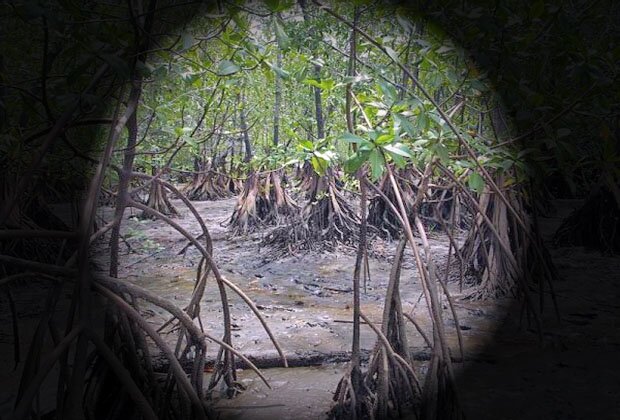
 Venezuela is estimated to have four percent of the world’s mangroves.
A unique and ecologically diverse mangrove woodland lines miles of Venezuelan coastline, on the northernmost extreme of South America.
The Venezuelan mangroves span over 2,200 square miles, ranking as one of the largest mangrove ecoregions in South America, but that number is shrinking steadily.
Recent satellite data shows that human actions are wiping out mangrove forests even faster than previous bleak estimates.
Conducted by the U.S. Geological Survey and NASA, the researchers found that mangroves comprise 12.3 percent less area than previously estimated.
In total, satellites reveal that mangrove forests cover approximately 53,290 square miles.
“Our assessment shows, for the first time, the exact extent and distribution of mangrove forests of the world at 30 meters spatial resolution, the highest resolution ever,” said Dr. Chandra Giri from USGS.
Along the shore of Lake Maracaibo near the Venezuelan coast, sediment and pesticide runoff from industrial logging operations is polluting the water among the mangroves and destroying the habitat of aquatic animals like crabs, fish, and shellfish.
Intensive mangrove logging near Lake Maracaibo began in World War II for exportation to Germany and the United States. Deforestation continued into the 1950s to accommodate the expansion of coconut plantations and oil extraction.
Although mangrove woodlands have not been systematically monitored, some evidences suggest dramatic losses during the last decades.
Mangroves are reported for most of Lake Maracaibo perimeter, whereas their present distribution is more restricted, threatened by urbanization and oil pollution and urban waste.
In other ecoregions the reduction is also remarkable.In Adícora (State of Falcón), Cumaná (Sucre), and at Píritu and Unare (Anzoategui), as well as along the coast of the State of Carabobo, where historical records afford evidence of extensive mangrove forests, they have disappeared almost entirely or only small patches are left.
The causes of such deforestation is unknown; however, it is probable that in some of those areas semi-industrial exploitation was carried out, or that small-scale extraction levels, to meet local needs, were constant for decades.
Venezuelan mangroves are specifically protected through a Presidential Decree, and many of the region’s mangrove forests are within the limits of high-ranking conservation units. However, there are exceptions that provide loopholes for further urban, tourist and demographic growth.
Gustavo Carrasquel | ANCA24
 La Tortuga Foundation asks the National Executive be incorporated into the Technical Committee that oversees tourism development plans of La Tortuga island.
Once again public, arbitrary policies without consensus, disrespect the work of scientists and conservationists who for years have preserved the spaces and natural habitats in Venezuela.
Alberto Boscari, president of La… Continue reading
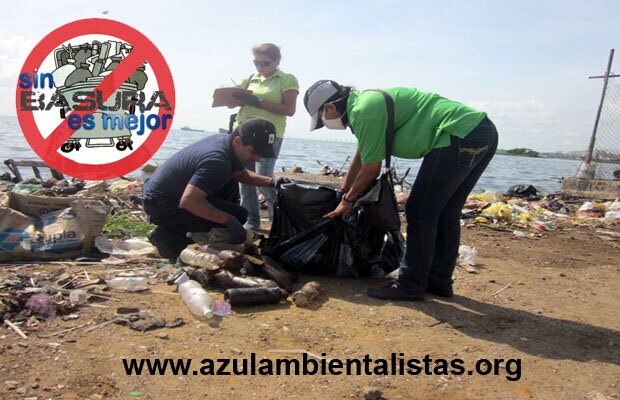 Environmentalists conduct a media tour in the region. Radio and television programs, as well as printed media, will be visited by the Blue Environmentalists Foundation executives, in the framework of its campaign “WITHOUT GARBAGE is better.”
Before the announcement and implementation of the Department of Environment of Zulia state, to dig a… Continue reading
 Recently, an international team of scientists, artists and educators launched an expedition to study the global marine debris crisis from one of the most breathtaking places on the planet: southwest Alaska.
The Gyre project is a collaboration between the Anchorage Museum and Alaska SeaLife Center, in partnership with several national and Alaska-based


